Peak Season Warehouse Safety: When Demand Changes the Risk
Nov 24th, 2026
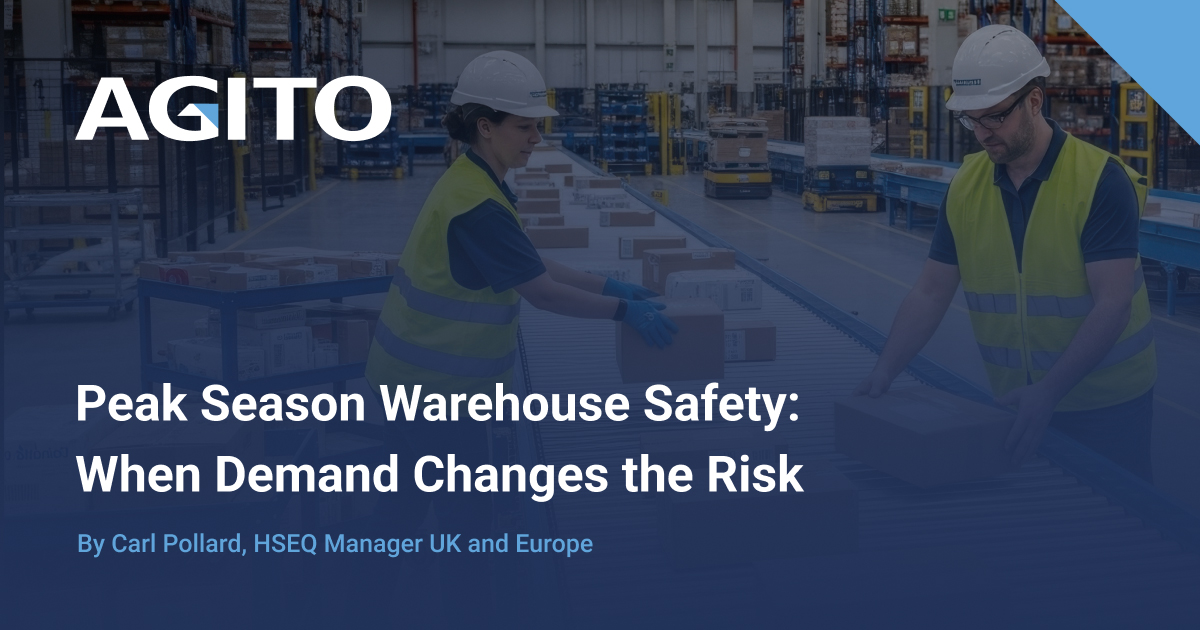
Peak season puts warehouse and distribution operations under sustained pressure. Volumes rise, equipment runs for longer and more people and vehicles share the same space, all while delivery deadlines tighten.
Most peak planning focuses on capacity. Can the equipment cope? Is there enough resource? Where are the bottlenecks? Peak season warehouse safety deserves the same scrutiny, because the conditions that test throughput also test the controls that keep people safe.
Carl Pollard, AGITO Global’s HSEQ Manager for the UK and Europe, explains where those controls come under strain in automated operations and what leaders should check.
Peak Season Warehouse Safety Starts With What Has Changed
Working conditions rarely change overnight during peak. They shift gradually, which makes new risks easy to miss.
Additional stock narrows walkways and temporary storage blocks sightlines. More deliveries mean more vehicle movements and more reversing, while contractors and visiting drivers may not know the site as well as permanent teams. None of these feels like a major change on its own. Put several together, and the site people work in today can be very different from the one that was originally risk assessed.
Where pedestrians, forklifts, automated guided vehicles (AGVs) and maintenance teams share space, that gap needs close attention. Review pedestrian routes, crossings, segregation and exclusion zones against actual peak activity, rather than assuming arrangements that work in a normal week still hold.
“Has the amount of movement changed while our controls have stayed the same?” – Carl Pollard
Asking people to be more careful will not hold up through a busy shift. Clear routes, good visibility and proper segregation make the safe option the easy one, even when the facility is at its busiest.
When the System Stops, the Risk Rises
Automation helps operations handle peak volumes. Yet one of the riskiest moments in an automated facility comes when the system stops.
A conveyor jams or a fault halts a sorter. Product starts to back up, dispatch deadlines come under threat and everyone, quite rightly, wants the system running again. That is when pressure starts to shape decisions, and when Carl hears phrases like these:
- “I’ll just have a quick look.”
- “It’ll only take a minute.”
- “I can reach it from here.”
- “If I clear this, we’ll be running again.”
Each one can lead to someone reaching through guarding, bypassing an interlock or entering an automated area without the right controls in place.
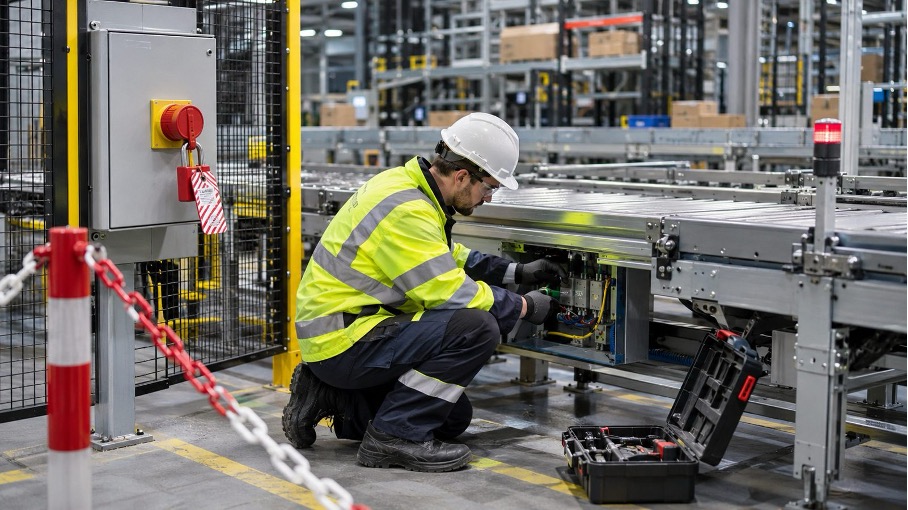
Trained and authorised personnel should follow the equipment-specific recovery procedure, including safe isolation where required, identifying and resolving the fault, and completing the necessary checks before authorising a restart. Leaders should check that teams have the training, time and authority to follow those procedures when a deadline is slipping.
System design plays a part too. When teams can see where a fault has occurred and what state the equipment is in, fewer people need to go looking for it. Clear guarding, interlocked access points and defined isolation zones make the safe route the practical one.
“Taking a few extra minutes to do something safely is far better than turning a production problem into an incident that affects someone for much longer.” – Carl Pollard
Maintenance Under Pressure: Keep the Controls in Place
Maintenance and engineering teams carry much of the responsibility for keeping automated systems available through peak. Longer operating hours increase wear and reduce the windows for planned maintenance, placing greater demands on maintenance teams when downtime is particularly disruptive.
When something critical fails, the first question is usually how quickly it can be running again. That urgency should never change how the work is done. If a task normally requires isolation, lockout/tagout, a risk assessment and method statement, a permit or controlled access, it still requires them during peak.
“Peak might change how urgently we need to fix something. It shouldn’t change how safely we fix it.” – Carl Pollard
Temporary repairs need particular care. A short-term fix may be the right call to keep an operation moving, but it should be assessed, authorised, recorded and tracked through to a permanent solution. Without proper follow-up, a temporary repair can remain in place long after peak has passed.
Leaders also need to back the engineer who says, “I need to make this safe before I can work on it.” That person is doing their job properly, even when it delays a restart.
Tired Teams and Rushed Handovers
Long shifts, overtime and weeks of sustained workload affect concentration, reaction time and judgement. That matters most for people driving equipment, working around automated systems, maintaining machinery or responding to faults. As Carl puts it, being fit for work during peak means being fit to make good decisions. Workforce plans should therefore cover breaks, supervision, manageable workloads and access to experienced support, as well as headcount.
Communication is the second pressure point. It tends to drop away exactly when an operation needs it most, and the warning signs sound familiar:
- “I thought it had been isolated.”
- “I assumed maintenance had finished.”
- “I thought the next shift knew about it.”
Better communication does not require more meetings or paperwork. A brief, structured handover should confirm:
- What has changed, and who needs to know?
- Who is responsible for the work, and who currently has control of the equipment?
- Is the intervention complete and the equipment confirmed safe?
- Who is authorised to return the system to operation?
- What does the next shift need to know?
These checks matter most when maintenance runs across shifts, or when contractors and site teams work around the same equipment.
Watch for “Just This Once”
Pressure rarely produces one dramatic shortcut. More often, small exceptions build up. Packaging collects in a walkway. A pallet is left near an access point “for a minute”. An equipment check is skipped because another team is waiting. Tools stay out because there is another job to get to.
Individually, none of these seems significant. Repeated over several busy weeks, they start to feel normal, and peak is the worst possible time to let the basics slip.
Carl sees the phrase “just this once” as a clear warning sign. Most people who take a shortcut are trying to help, whether that means clearing a fault, supporting a colleague or keeping a customer’s orders moving. That good intention is exactly why these habits go unchallenged.
People need the confidence to question unsafe practices, report near misses and stop work when conditions change. Leaders reinforce that confidence by acting on concerns, including when the response affects output.
“Sometimes speaking up is the most important contribution someone can make.” – Carl Pollard
Peak Performance Is a Leadership Responsibility
A safe, successful peak depends on coordinated decisions across operations, engineering, maintenance and HSEQ. As demand rises, leaders need a current picture of where conditions have changed and whether their controls are still working. Three questions provide a useful starting point:
- What has changed? Have volumes, staffing, vehicle movements, working areas or operating hours introduced risks that need reassessing?
- Are our controls still effective? Can teams manage faults, maintenance and day-to-day operation safely under current conditions?
- Do our people have the authority and support to make the right call, particularly when stopping work or following procedure could affect short-term output?
Carl adds one more test that anyone on site can apply: if this wasn’t peak, would I still think this was OK?
AGITO Global’s engineering, integration and service teams work alongside the people who operate and maintain automated facilities throughout the year, including the busiest weeks of peak. Read more about our commitment to safety and our Service & Support capability.
To discuss safety, service and support for your automated operation, speak to our team.
“Peak changes the pressure, not the standard.” – Carl Pollard
About the Author
Carl Pollard is HSEQ Manager for the UK and Europe at AGITO Global, overseeing health, safety, environmental and quality standards across the business.
He holds a NEBOSH Level 6 National Diploma in Occupational Health and Safety Management and is a Technical Member of IOSH (TechIOSH). With a background in operations and maintenance engineering, Carl combines technical knowledge with practical expertise in workplace safety and risk management.
He also led AGITO Global’s ISO 9001:2015 certification process, supporting the development of its Quality Management System.